

High-Performance Pneumatic Fastening Solutions for Every Application
Pneumatic fastening tools have been the backbone of industrial assembly and maintenance for decades, offering an excellent balance of power, speed, durability, and low operating cost. From heavy-duty maintenance work to high-volume production lines, air-powered tools remain a proven solution for improving productivity and reducing operator fatigue.
However, not every fastening application requires the same type of tool. Air impact wrenches, air impulse wrenches, and air shutoff wrenches are each designed for different fastening objectives—from rapid bolt seating to precision torque control on critical assemblies.
At NMS, we help manufacturers select the right pneumatic fastening technology based on torque requirements, joint characteristics, production volume, and quality expectations.
[ Air Impact Wrench ]
High power and fast screw seating for maintenance and heavy-duty applications.
[ Air Impulse Wrench ]
Reduced reaction force with improved torque repeatability for production assembly.
[ Air Shutoff Wrench ]
Automatic clutch shutoff for accurate, repeatable torque in quality-critical manufacturing.
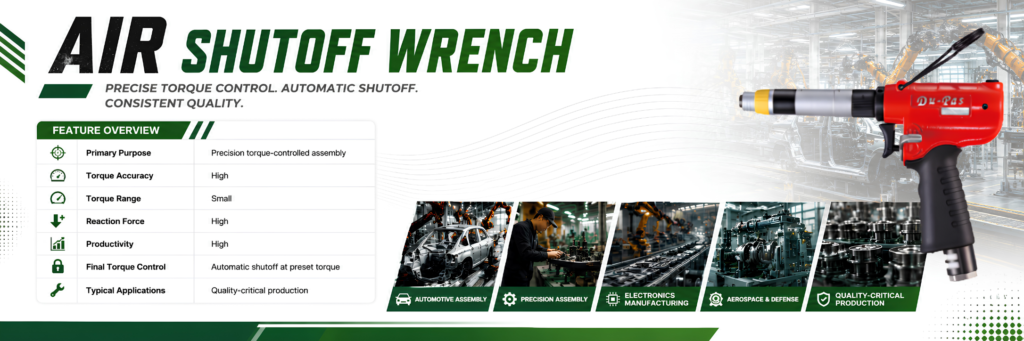
| Feature | Air Impact Wrench | Air Impulse Wrench | Air Shutoff Wrench |
|---|---|---|---|
| Primary Purpose | Fast screw seating & maintenance | Fast Production Assembly | Precision torque-controlled assembly |
| Torque Accuracy | Low | Medium to High | High |
| Torque Range | Large | Medium | Small |
| Reaction Force | Low | Low | High |
| Productivity | Excellent | Excellent | High |
| Final Torque Control | None | Better repeatability | Automatic shutoff at preset torque |
| Typical Applications | Maintenance, heavy equipment, general industries | Automotive & industrial assembly | Quality-critical production |
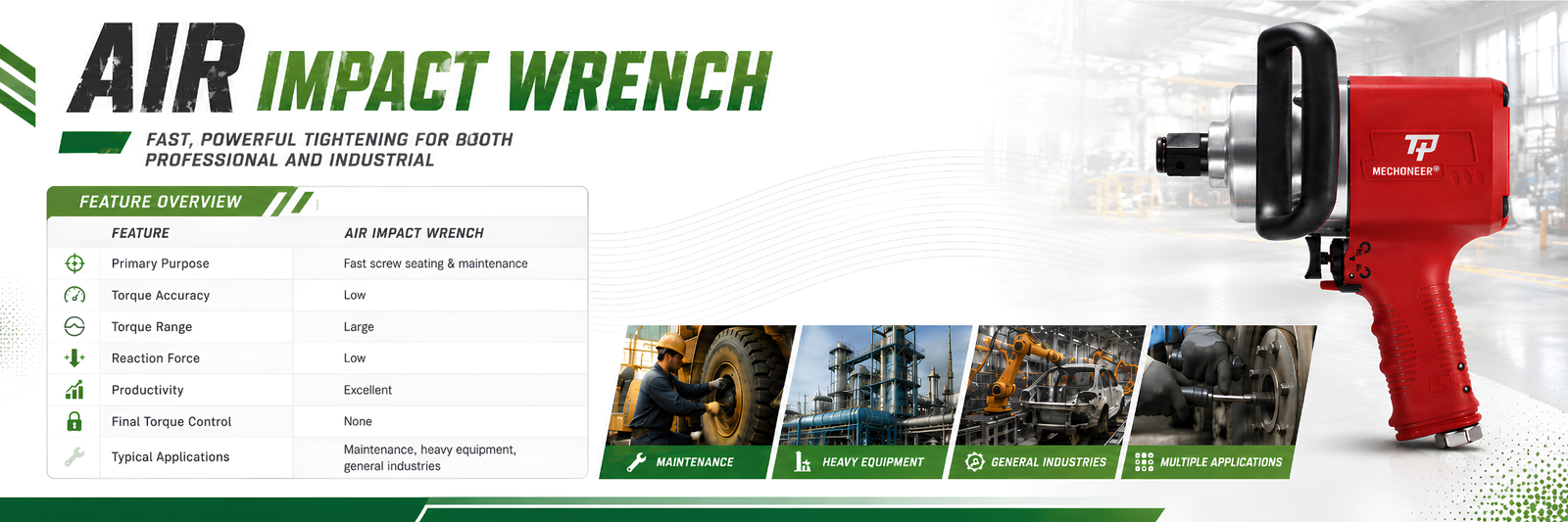
Air Impact Wrench
Fast, Powerful Tightening for both Professional and Industrial
Air impact wrenches are among the most versatile and widely used pneumatic tools in the world. Their powerful hammer mechanism delivers high torque output while allowing fast installation and removal of bolts and nuts, making them indispensable in maintenance workshops, automotive service centers, heavy equipment repair, and industrial manufacturing.
Unlike precision tightening tools, impact wrenches prioritize speed and power. They are ideal for quickly loosening seized fasteners or rapidly seating screws and bolts before final torque is applied.
Professional Maintenance Applications
Maintenance professionals rely on air impact wrenches for equipment repair, preventive maintenance, and machine installation where productivity is critical. Their ability to remove rusted or high-torque fasteners significantly reduces operator effort compared to manual tools.
Common applications include:
- Automotive repair and tire service
- Heavy equipment maintenance
- Plant shutdown maintenance
- Construction machinery repair
- Steel fabrication
- General industrial maintenance
Industrial Manufacturing Applications
In production environments, air impact wrenches are commonly used for fast screw seating during the initial stage of assembly. Their high rotational speed allows bolts and nuts to be installed rapidly, reducing overall cycle time.
For quality-critical assemblies, the impact wrench is typically used only to seat the fastener. Final tightening is then completed using a calibrated torque wrench or a torque-controlled shutoff tool to achieve the specified torque accurately.
This two-step process combines the speed of an impact wrench with the precision required for modern manufacturing.
Key Benefits
- High power-to-weight ratio
- Extremely fast bolt installation and removal
- Excellent for maintenance and repair
- Reduces operator fatigue
- Ideal for high-volume screw seating operations
- Suitable for heavy-duty industrial applications
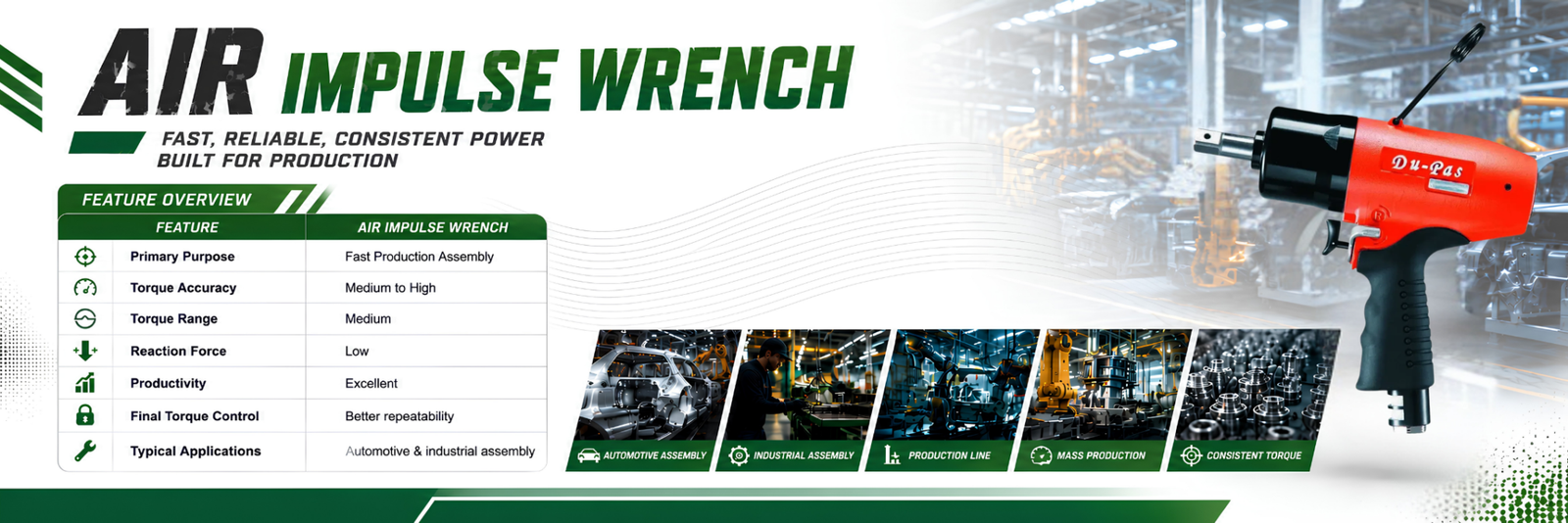
Air Impulse Wrench
Fast, Comfortable, and More Accurate Pneumatic Fastening
Air impulse wrenches combine the speed of an impact wrench with the improved torque control required for industrial assembly. Instead of using a traditional hammer-and-anvil mechanism, an impulse wrench generates torque through a sealed hydraulic pulse unit. This design greatly reduces vibration, noise, and reaction force while delivering smoother and more consistent tightening performance.
Compared with conventional impact wrenches, impulse tools provide better torque repeatability, making them suitable for production assembly where both productivity and fastening quality are important.
At NMS, we offer Tranmax Dupas (DUPAS) impulse wrenches, trusted by manufacturers worldwide for their durability, operator comfort, and reliable performance. Available in In-line (Straight), Angle, and Pistol configurations, Dupas tools can be selected to suit virtually any workstation or assembly application.
Why Choose an Air Impulse Wrench?
Many production lines require a tool that is faster than a shutoff wrench but offers better torque consistency than an impact wrench. Air impulse tools fill this gap perfectly.
Their hydraulic pulse mechanism delivers smooth bursts of torque with minimal kickback, allowing operators to work longer with less fatigue. The reduced reaction force also improves ergonomics and makes the tools easier to control, particularly when tightening medium-torque fasteners throughout an entire shift.
Because of their speed and improved repeatability, air impulse wrenches are widely used in automotive assembly, electronics manufacturing, appliance production, metal fabrication, and general industrial assembly.
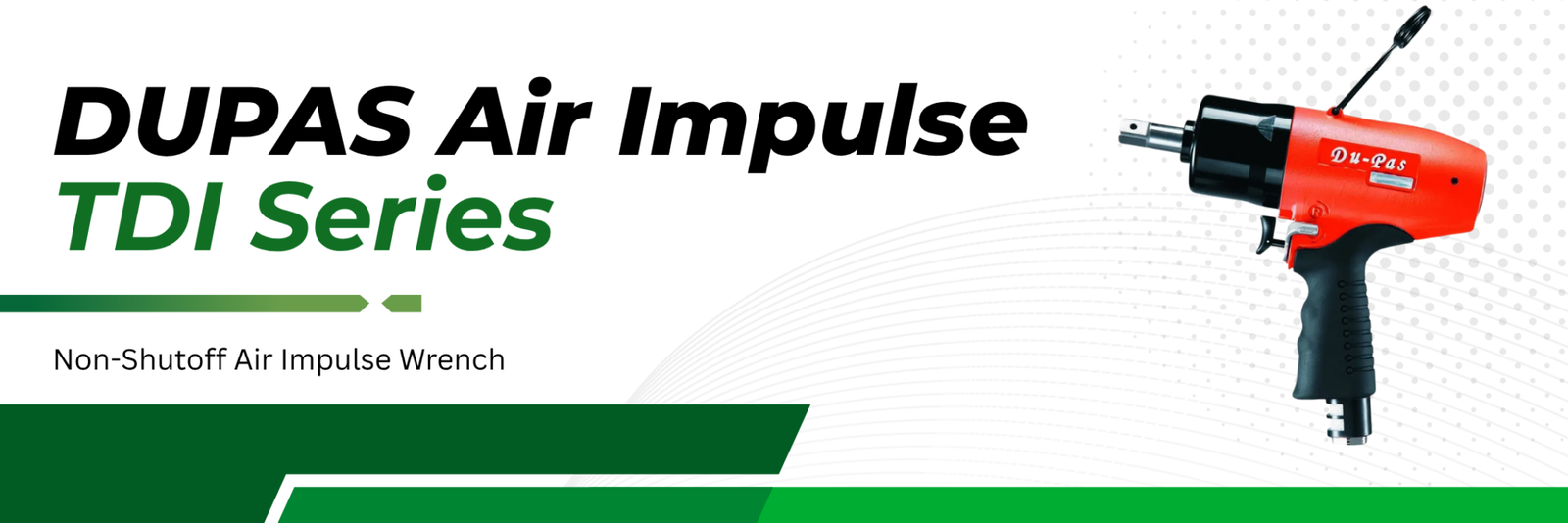
Dupas Air Impulse Wrench Series
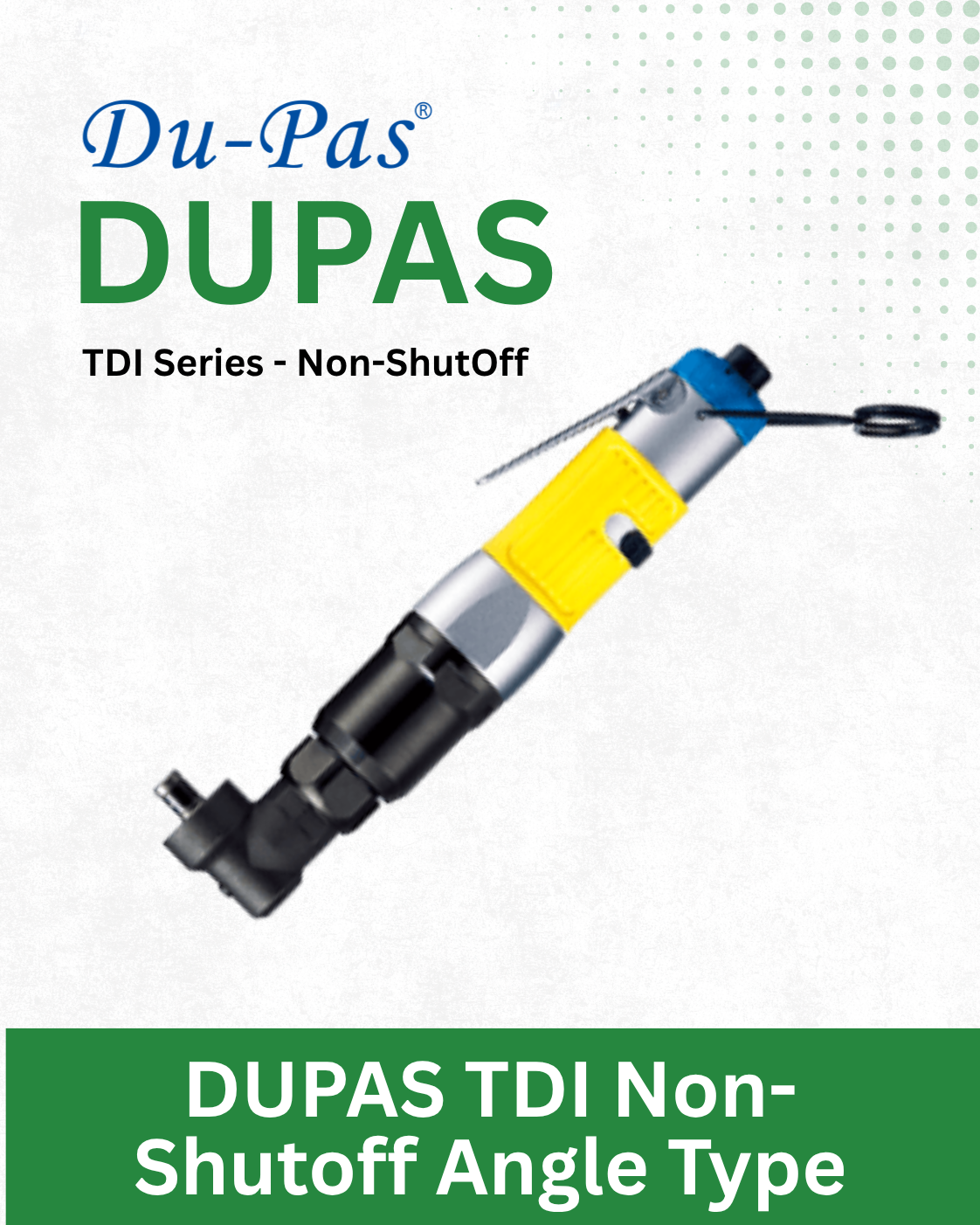
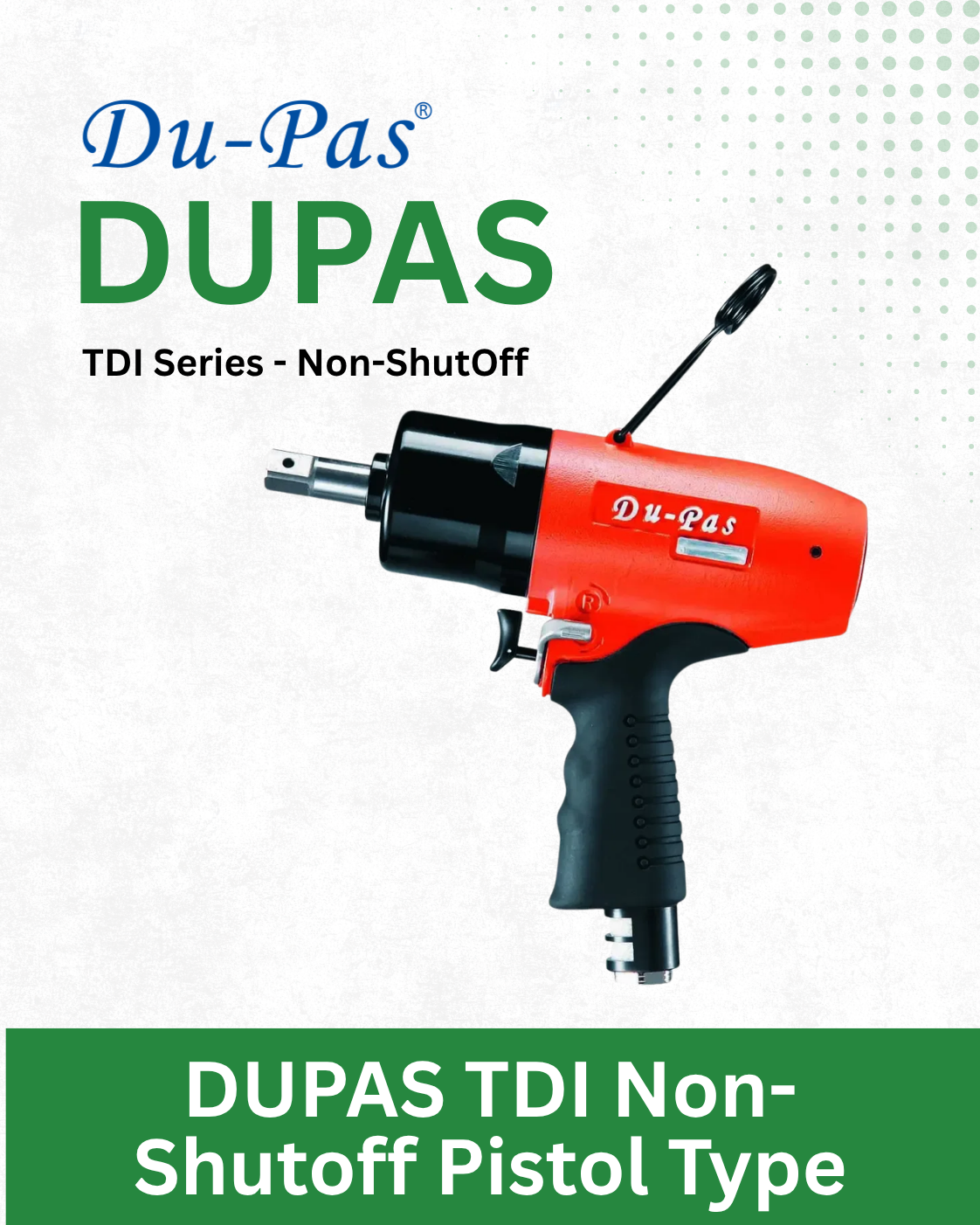
TDI Series – Non-Shutoff Air Impulse Wrench
The Dupas TDI Series delivers fast and powerful tightening using hydraulic impulse technology without an automatic shutoff mechanism. It is ideal for applications where high productivity and operator comfort are priorities, while final torque verification may be performed using separate quality control procedures.
The TDI Series offers excellent balance, reduced vibration, and significantly lower reaction force than conventional impact wrenches, making it suitable for continuous production environments.
Typical Applications
- General industrial assembly
- Automotive component assembly
- Appliance manufacturing
- Metal fabrication
- Medium-torque repetitive fastening
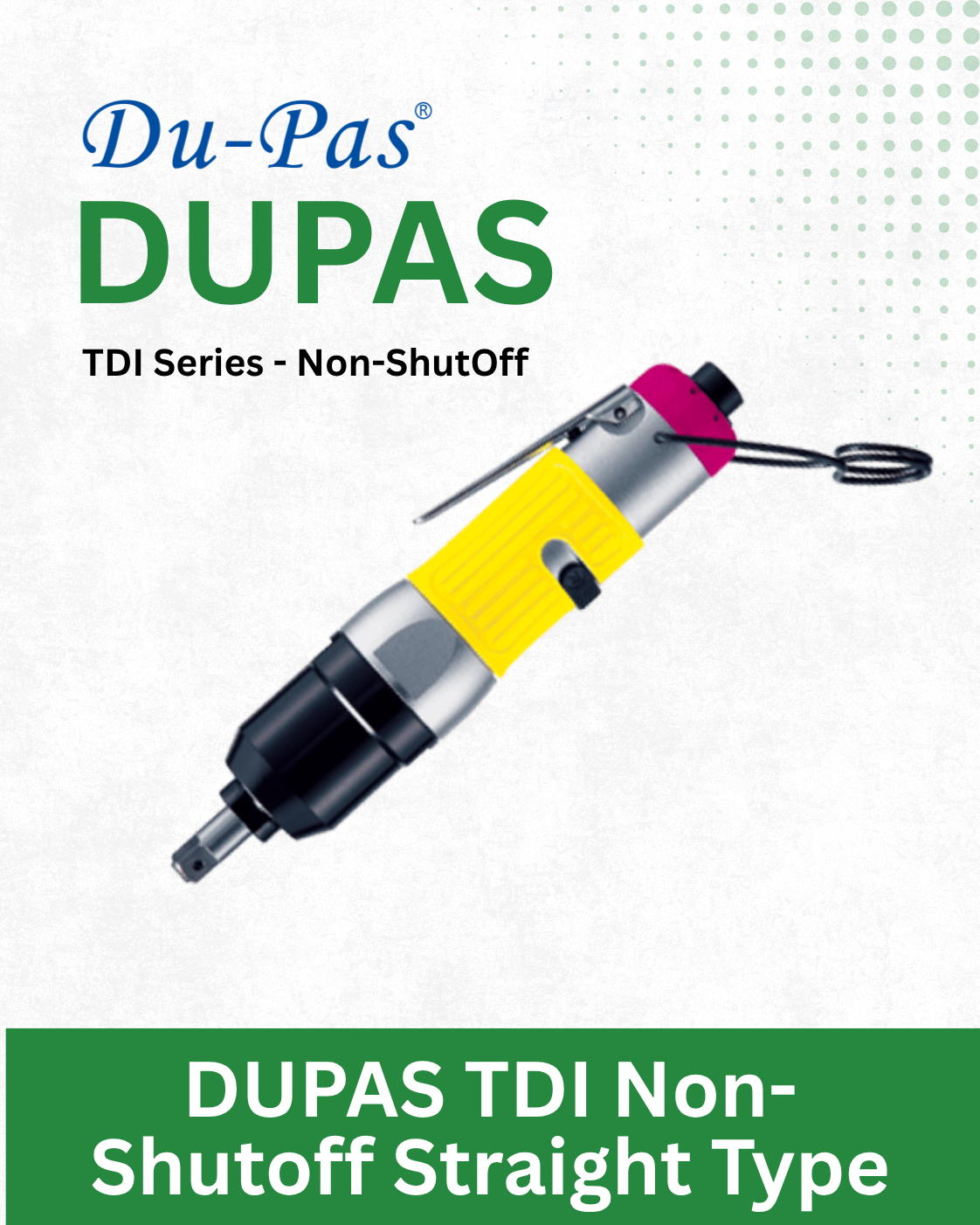
TDIS Series – Shutoff Air Impulse Wrench
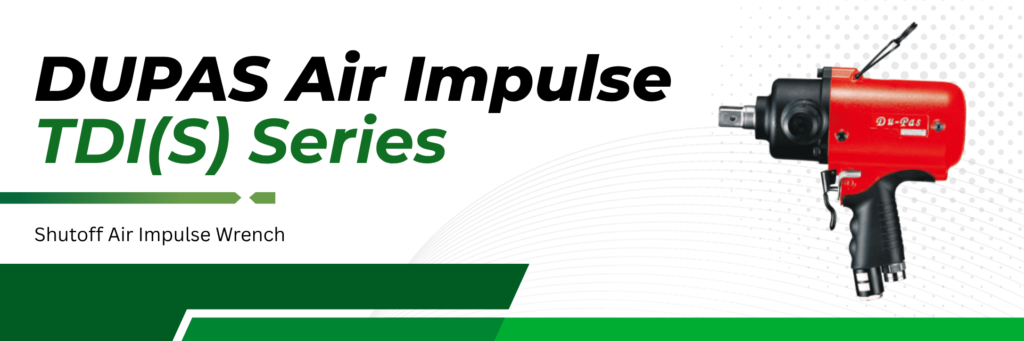
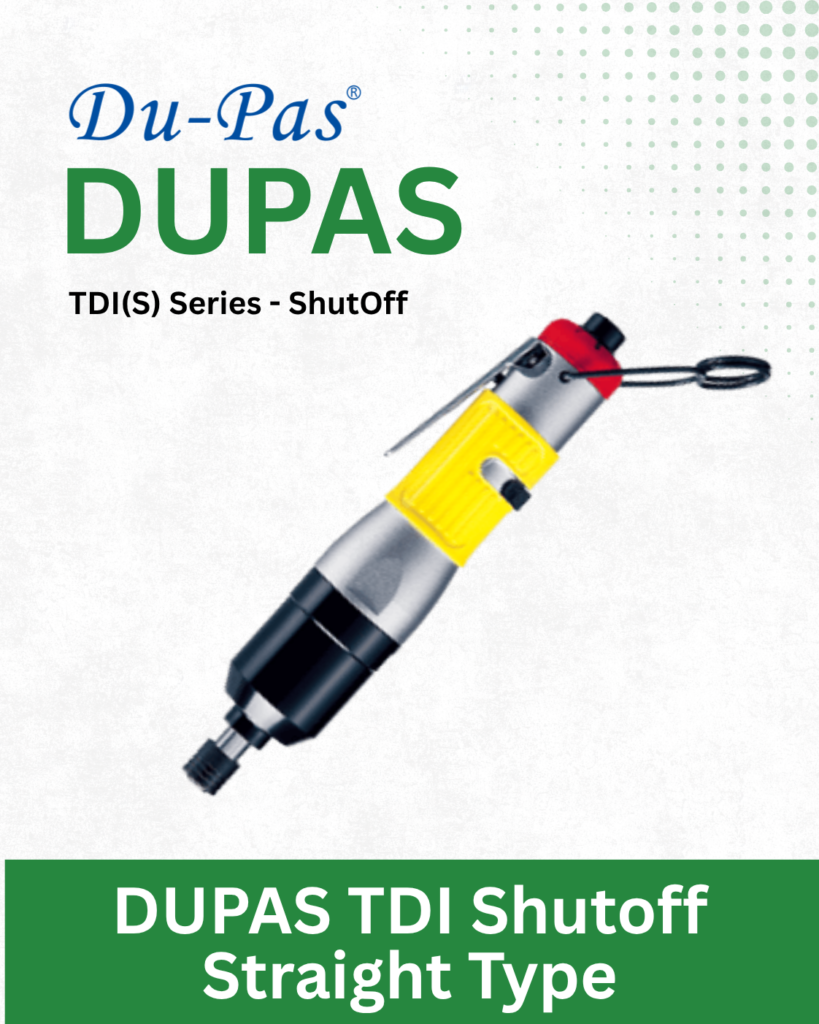
The Dupas TDIS Series combines the benefits of hydraulic impulse technology with an automatic shutoff clutch. Once the preset torque is reached, the tool automatically stops, helping to improve torque repeatability while reducing the risk of over-tightening.
This makes the TDIS Series an excellent choice for production lines where fastening quality is critical but manufacturers still require the speed and ergonomic advantages of an impulse tool.
Automatic shutoff also minimizes operator variation, improving process consistency across multiple shifts and operators.
Typical Applications
- Automotive assembly
- White goods manufacturing
- Electronics production
- Quality-critical assembly operations
- Medium-volume to high-volume manufacturing
Available Configurations
To suit different workstation layouts and operator preferences, Dupas air impulse wrenches are available in several configurations:
- In-line (Straight) – Ideal for vertical fastening and confined spaces where direct access to the fastener is available.
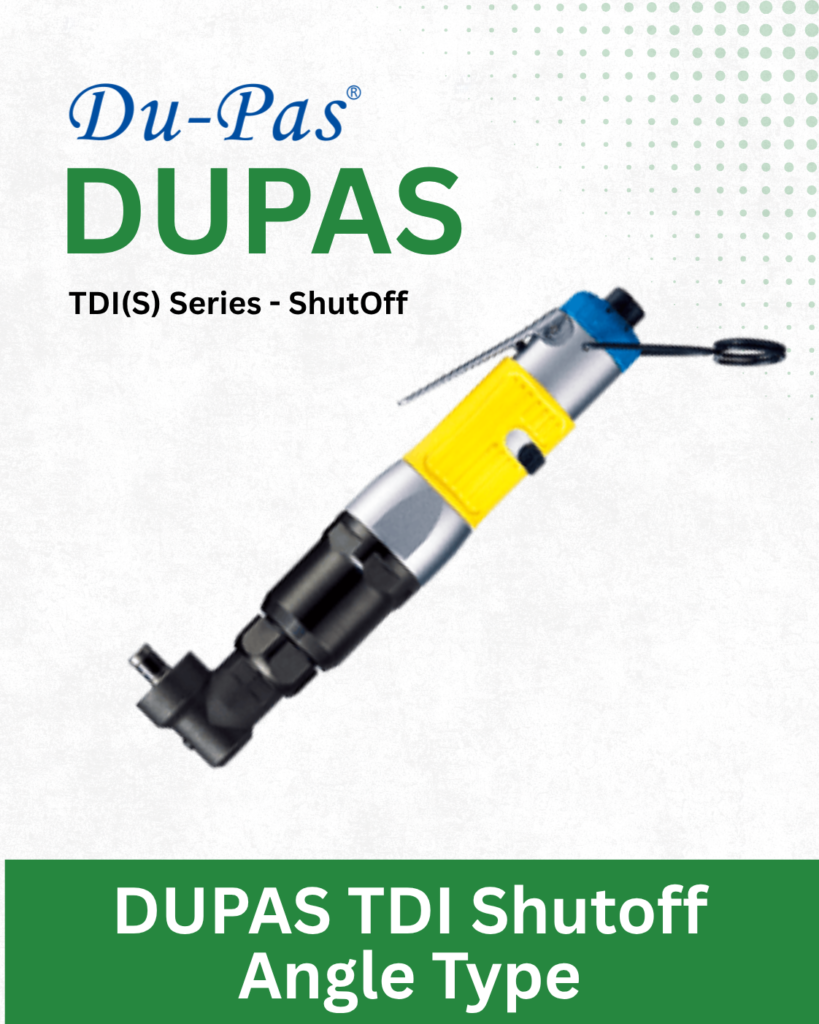
- Angle – Designed for applications with limited clearance or difficult-to-reach fastening locations.
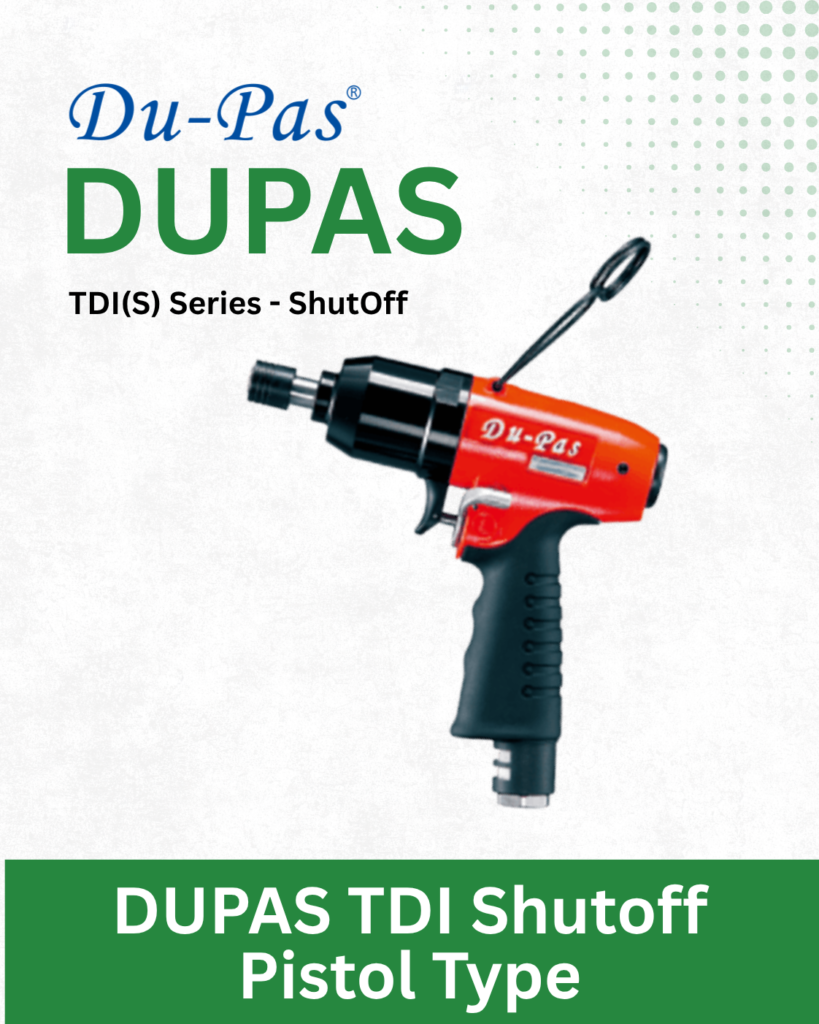
- Pistol Grip – The most common configuration, providing excellent ergonomics and control for general assembly work.
Air Shutoff Wrench
Precise and Repeatable Tightening for Quality-Critical Assembly
Air shutoff wrenches are designed for industrial assembly applications where torque accuracy, repeatability, and process consistency are more important than maximum tightening speed or torque capacity. Unlike impact and impulse tools, a shutoff wrench uses a precision clutch mechanism that automatically stops the tool when the preset torque is reached.
This automatic shutoff reduces dependence on operator judgement and helps ensure that each fastener is tightened consistently. The result is a controlled fastening process suitable for high-volume production environments where joint quality must be maintained across different operators, shifts, and workstations.
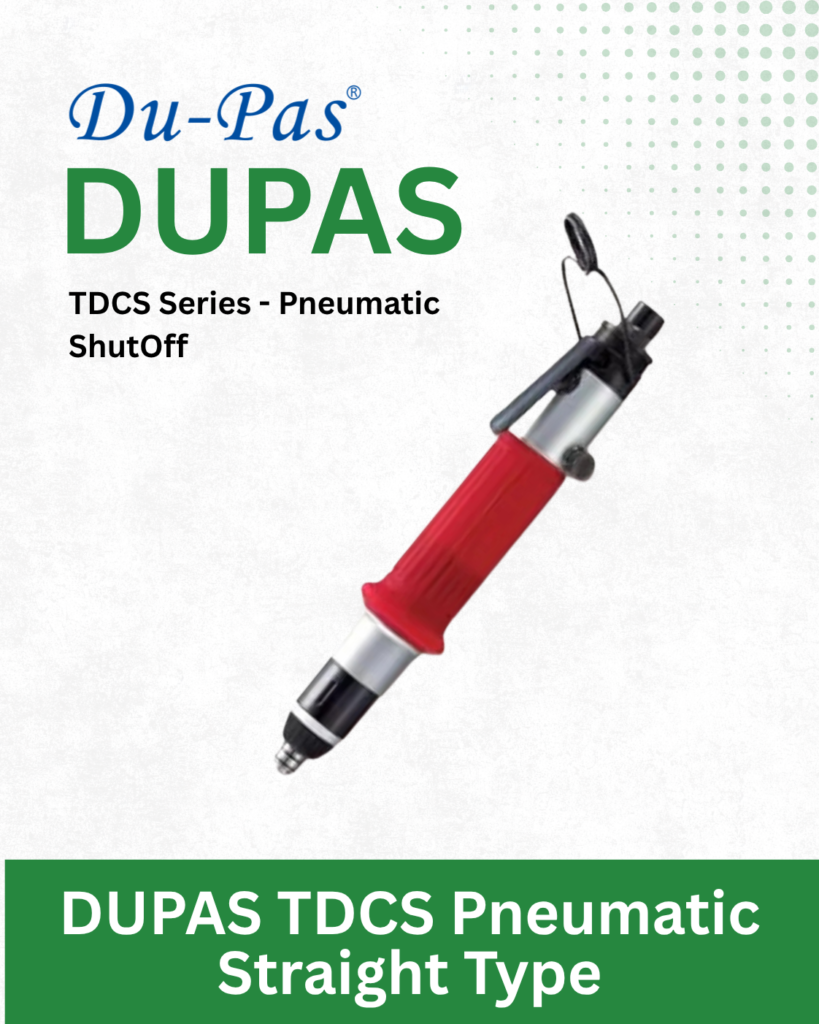
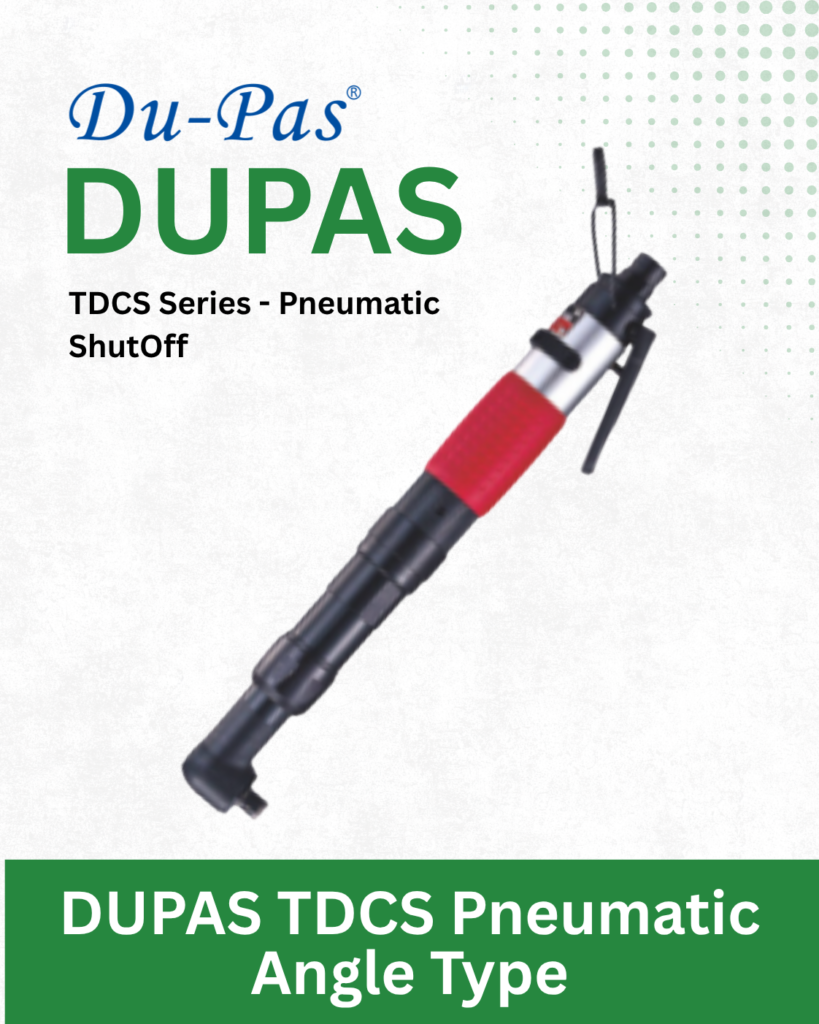
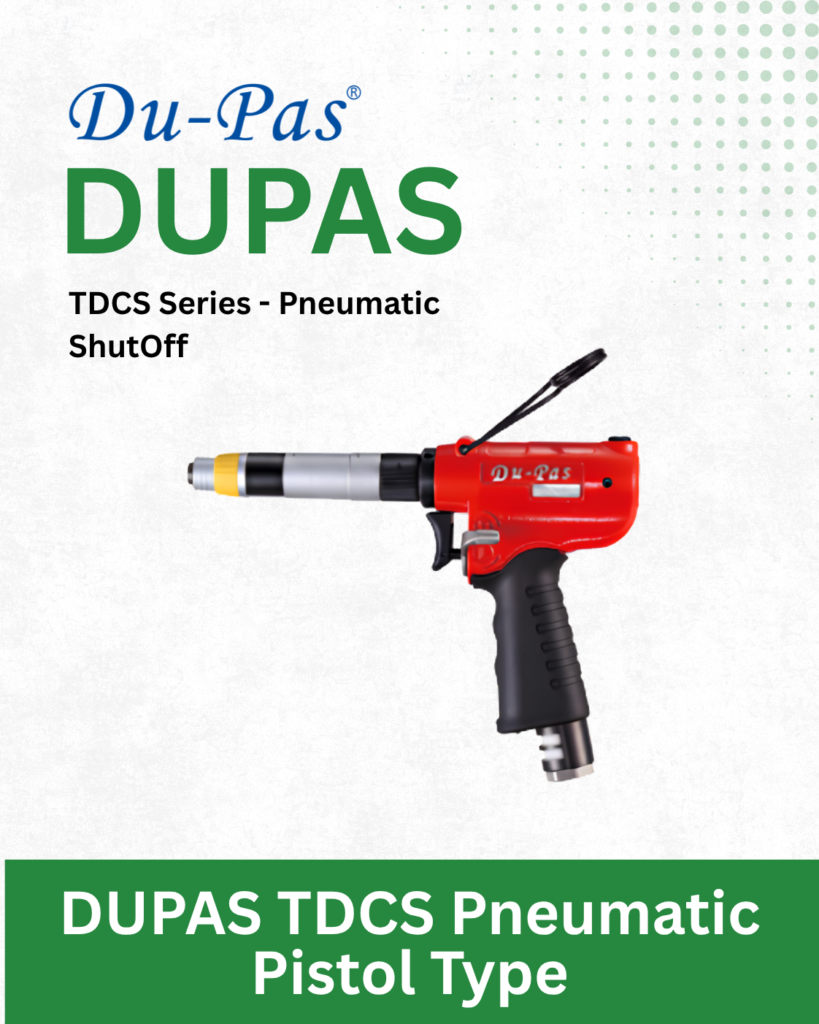
At NMS, we offer the Dupas TDCS Series of pneumatic shutoff tools. The range is available in Pistol, Angle, and Straight configurations, allowing the tool to be matched to different fastener positions, workstation layouts, and accessibility requirements.
How a Shutoff Clutch Works
During tightening, the tool rotates the fastener continuously until resistance in the joint reaches the preset level. At that point, the clutch activates and automatically shuts off the air supply to the motor.
Because the tool stops at a controlled setting rather than relying on the operator to release the trigger, shutoff tools provide much better repeatability than conventional impact wrenches. They are particularly effective on joints with consistent fastening conditions, where accurate torque control is required over thousands of repeated cycles.
The clutch setting can be adjusted according to the required tightening torque and should be validated against the actual production joint using a suitable torque measurement method.
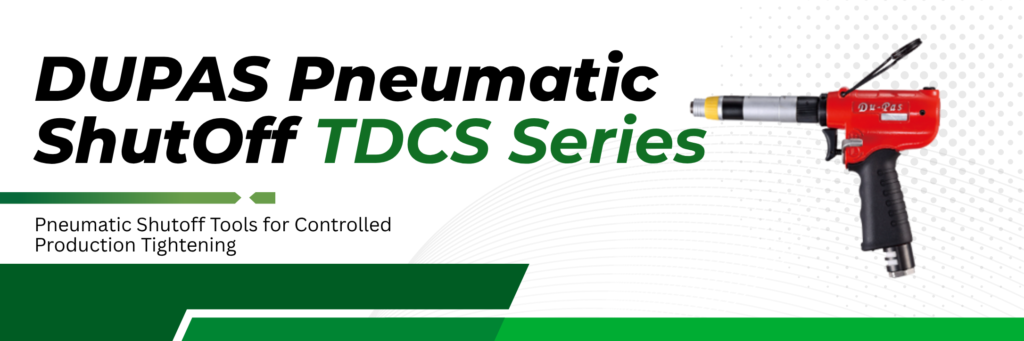
Dupas TDCS Series
Pneumatic Shutoff Tools for Controlled Production Tightening
The Dupas TDCS Series combines a precision shutoff clutch with a durable pneumatic motor to deliver accurate and repeatable tightening in industrial production.
The tool automatically stops once the preset torque is reached, helping prevent both under-tightening and excessive tightening. This makes the TDCS Series suitable for assembly lines where consistent joint quality is required but full tightening-data collection is not necessary. Compared with more complex transducerized systems, pneumatic shutoff tools provide a practical and cost-effective solution for controlled fastening while remaining straightforward to operate and maintain.
High Accuracy and Repeatability
The main strength of an air shutoff wrench is its ability to deliver consistent tightening results. Its controlled clutch mechanism minimizes operator influence and produces significantly better repeatability than impact tools.
This makes it well suited for fastening applications involving:
- Automotive components
- Home appliances and white goods
- Electronics and electrical products
- Pumps, motors, and industrial equipment
- Metal and plastic assemblies
- General high-volume manufacturing
However, actual torque performance still depends on the joint condition. Fastener friction, material variation, prevailing torque, joint stiffness, air pressure, socket condition, and tool setup can all affect the final achieved torque. Proper application testing remains essential before the tool is introduced into production.
Torque Capacity and Reaction Force
One limitation of a conventional shutoff wrench is its maximum practical torque output. Because the motor applies torque continuously until the clutch shuts off, the corresponding reaction torque is transferred back through the tool body to the operator or supporting fixture.
As tightening torque increases, the operator must resist a greater reaction force. This can cause fatigue, reduce tool control, and create ergonomic or safety concerns during repetitive work.
For this reason, direct-drive shutoff tools are generally used for low- to medium-torque applications.
Higher-torque models may require a torque reaction arm, support fixture, or other reaction device to prevent the operator from absorbing the full reaction force.
Where higher torque is required without strong operator reaction, an impulse wrench, reaction-controlled electric nutrunner, or fixtured tightening system may be more appropriate.
Available Tool Configurations
Pistol Type
The pistol configuration provides a natural grip and good control for general horizontal and front-facing fastening. It is commonly used in automotive components, appliances, machinery, and general assembly lines.
Angle Type
Angle shutoff tools are designed for fastening points with limited overhead clearance or restricted access. The angled head makes them suitable for side-facing fasteners, confined assemblies, and applications where a pistol tool cannot align directly with the joint.
Straight Type
Straight or in-line tools are ideal for vertical fastening and bench assembly. Their slim body allows easier access to narrow spaces and works particularly well when suspended from a spring balancer or installed with a torque arm.
Key Benefits
- Automatic shutoff at the preset torque
- High torque accuracy and repeatability
- Reduced dependence on operator judgement
- Lower risk of under-tightening and over-tightening
- Suitable for repetitive, high-volume assembly
- Simple operation and maintenance
- Cost-effective alternative to transducerized tools
- Available in Pistol, Angle, and Straight configurations
- Compatible with torque arms and reaction fixtures
When to Choose an Air Shutoff Wrench
Choose an air shutoff wrench when your production process requires consistent torque results, but does not require individual tightening data to be recorded for every fastener. It is particularly suitable when:
- The joint conditions are reasonably consistent.
- The required torque falls within a practical direct-drive range.
- Production volume is high.
- Operators perform repeated tightening throughout the shift.
- Automatic stopping is preferred over operator-controlled tightening.
- Traceability is not mandatory.
For applications requiring torque-and-angle monitoring, tightening curves, result storage, or complete traceability, a transducerized DC tool would be the more appropriate solution.